AI workflow integration for ops & compliance

Make processes consistent.Reduce exceptions.Move faster with AI.

I assess and improve document-heavy AI workflows for operations and compliance teams at small and mid-sized US companies: internal assistants, policy lookups, document extraction. Start with a scoped assessment of your current process, where it fails, and whether a build is worth it.

  • Cited answers your auditors can check
  • Runs where your data already lives
  • Measured against a baseline before anything goes hands-off

No obligation · or see the interactive demo ↓

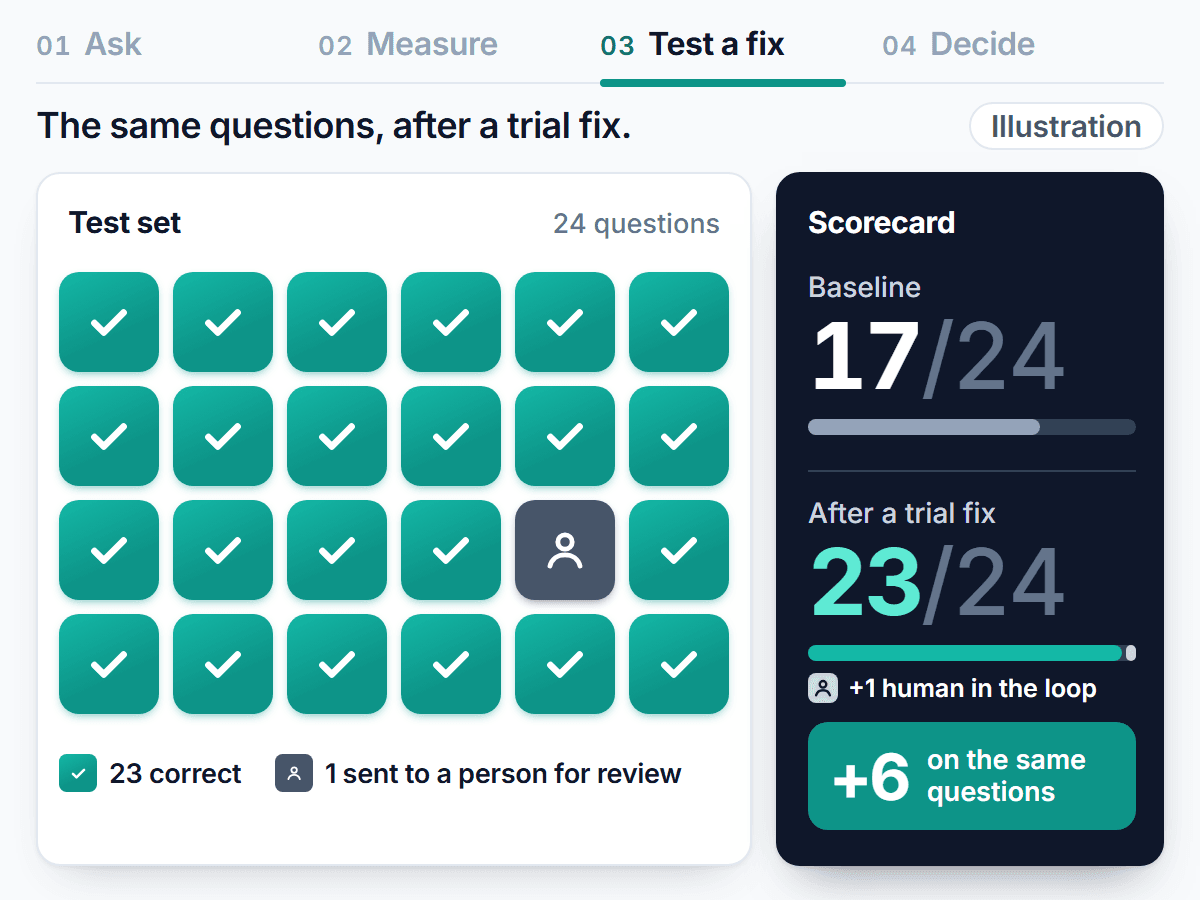
Illustration of a 24-question test set scored before and after a trial fix: 17 correct at baseline, 23 after, and one question sent to a person for review.
Illustration of the method. Measured results are in the published studies.
years in software engineering
15+
years working with AI/ML models
10+
published studies, each with its methods, results and limitations
3
weeks for a typical pilot on one workflow
8–10

Published Studies

Evidence-based evaluations to inform deployment decisions

Latest Study · Engagement rehearsal

From 82% to 95% on One GPU: An Engagement Rehearsal on a Synthetic Benefits Corpus

A full engagement rehearsal on a synthetic benefits-administration corpus: an assessment measured the baseline and ruled out the expensive fixes with data, then structured retrieval for tabular documents and a 14B open-weight model on the same single GPU took answer accuracy from 82.2% to 95.0% on the fixed 180-question test (peak build), with a deterministic auto-accept path that answered 13 of 43 tabular lookups with zero errors.

peak-build answer accuracy, same GPU (171/180, synthetic replica)Measured in a controlled test
82% → 95%
tabular lookups auto-accepted with zero errors (deterministic path)Measured in a controlled test
13/43
paired gain on the same 180 questions (27 fixed, 4 regressed)Measured in a controlled test
+12.8 pp

View all studies →

Results come from specific benchmarks and a rehearsal on specific data; yours will differ.

Generic AI Isn’t Grounded in Your Business

Off-the-shelf tools answer well only once they are connected to your documents, your rules and a way to check them.

  • Missing context

    Effective AI needs to understand your specific policies, terms, and workflows.

  • Lack of integration

    Most AI tools sit beside your workflow, not inside it.

  • Privacy and compliance

    Sending proprietary information to third-party APIs can create compliance risk.

See It In Action

Five scripted scenarios on sample documents, modeled on how a production deployment behaves: cited answers, guardrails that stop and escalate, and a decision log. You pick from suggested questions; the only record is a transient connection log, described in the privacy policy.

Scenarios

  • HR Policy Assistant

    Remote work, stipends, and expenses answered from versioned HR policy — with a privacy-safe handoff.

  • Contract Intake Assistant

    Clause extraction and playbook risk flags on sample contracts, with approval-gated redlines.

  • E-Commerce Support

    Returns, exchanges, and damaged-item intake resolved against store policy — exceptions included.

  • Manufacturing SOP + Safety Compliance

    A lockout/tagout walkthrough with OSHA-cited safety gates that stop and escalate when rules require.

  • Technical Documentation Q&A

    Version-aware API troubleshooting that cites the docs — and files an issue when docs are missing.

Sample exchange (HR Policy Assistant)

Remote work policy for my role

Here's the remote work policy for your role:

Eligibility: Full-time employees in eligible roles may work remotely up to 3 days/week.

Approval: Manager approval required; documented in HR system.

Expectations: Core hours 10am-3pm local time; reliable internet required.

Source: Remote_Work_Policy_v2025.10 §2.1

Remote Work Policy v2025.10 · Section 2.1: Eligibility and approval

Full-time employees in roles designated as remote-eligible may work remotely up to 3 days per week. A remote work arrangement requires the approval of the employee's manager, and the approved arrangement is documented in the HR system before it starts.

Employees working remotely are available during core hours, defined as 10am to 3pm local time, and maintain a reliable internet connection at the remote location. Arrangements that exceed 3 days per week are handled under the exception provisions of the HR Handbook.

Sample document text written for this demo; not a real organization’s document.

Decision log: what a production system records for audit

INFO authz.check user=j.alvarez user_groups=["Employee"] allowed_sources=["HR_*","Expense_*"]
INFO nlu.classify intent=remote_work_policy confidence=0.93

The interactive version loads here; pick a scenario to run it.

Want a deeper look? More detailed demos are available during a free consultation.

From Documentation to Deployment

A clear, collaborative process: pilot engagements typically run 8–10 weeks from kickoff to a working system on one workflow

  1. 1

    Discovery & Planning

    Together, we identify the highest-impact workflows and define success criteria.

  2. 2

    Data Preparation

    Your documentation is transformed into structured, searchable knowledge.

  3. 3

    Configuration & Evaluation

    Retrieval and prompts tuned, fine-tuning only if testing shows it helps, then measured against real questions from your team.

  4. 4

    Integration & Deployment

    The solution is deployed and connected to your existing tools with clear documentation.

Why Work With an Independent Consultant

High-trust delivery without unnecessary complexity

About the practice

years in software engineering
15+
years working with AI/ML models
10+

The consultant behind RCTK, on LinkedIn

  • AI systems running in production across multiple industries
  • Evidence-first: the methods, results, and limitations of every study are published
  • Rhode Island–based, working exclusively with US companies
  • Insured before any engagement starts: professional liability (E&O), cyber, and general liability
  • Free consultation and initial discovery; pilots typically run 8–10 weeks
  • Security-first deployment

    Deployment options that fit your risk profile, with clear boundaries around data handling.

  • Direct collaboration

    Work directly with the person building the solution: no handoffs, no translation loss.

  • Right-sized delivery

    Focused solutions that improve a defined workflow, with measurable success criteria.

  • Clear documentation

    You get implementation notes, handoff docs, and practical training so the work is maintainable.

  • Discretion

    Sensitive details stay need-to-know. Controls and access are designed intentionally.

Technologies & Tools

Built with proven foundations

I work with models and tools that keep you in control, so your solution is auditable, maintainable, and avoids unnecessary vendor lock-in.

Common Questions

Answers to frequently asked questions about working together

How do you scope a project?

You and I start with a short discovery call, then I send a fixed written proposal, or recommend a scoped assessment first. The consultation and initial discovery are free.

How much does it cost?

The consultation and initial discovery are free, with no obligation. After scoping, you receive a fixed written proposal, so the price is known before you commit to anything. I don’t publish rates because scope varies widely between projects, but there is no cost to finding out what yours would be. The scoped assessment page describes the first paid step and what it delivers.

What the scoped assessment covers →

How long does a typical project take?

Most pilot engagements run 8–10 weeks from kickoff to a working system on one workflow, in your environment. Larger integrations are delivered in phases, with working software at each milestone rather than a single big handoff.

Do you work with companies that are not based in the US?

I work exclusively with US-based companies. This keeps contracting, data residency, and compliance requirements straightforward for both sides.

How do you measure accuracy and reduce hallucinations?

I define a test set of real questions from your team, measure answer quality against your source-of-truth, and iterate. The system is designed to cite sources when possible and to say it doesn’t know when the documentation doesn’t support a confident answer.

What happens after launch?

You can choose a full handoff with documentation and training, or a monthly support agreement that covers monitoring review, content updates and reindexing, model-upgrade evaluation and a backlog of small improvements. Support runs in Eastern business hours, Monday to Friday, with written response targets by severity: a critical issue is acknowledged within four business hours and worked the same day, a major one within one business day. There is no 24/7 or weekend coverage, and I don’t offer it. Planned absences are announced at least two weeks ahead, and because your team holds the infrastructure, accounts and credentials from day one, the system keeps running without me. If I am unexpectedly unavailable, your team already holds every credential and runbook, so nothing depends on my access.

What if I’m not satisfied with the results?

Work is delivered in clearly defined stages with review checkpoints. If the solution isn’t meeting the agreed success criteria, you can pause or stop after any milestone with no lock-in.

Why not just turn on the AI assistant built into software we already own?

Try it first; the assessment does. The assistants bundled with office and document platforms answer from the content you already store there, with your existing permissions, and for routine lookups that may be enough. Where they tend to fall short is where this practice works: finding the one authoritative table among near-duplicate documents, citations a reviewer can check against a source of record, a measured answer to how often the tool declines when it should, superseded versions, documents and logs that stay in your environment, and extracted data routed into your systems. A scoped assessment runs the tool you already own against the same question set as any build, so “configure what you have” is a real outcome and you don’t pay for custom work the tool already does.

What kind of documents can you work with?

Most text-based content works: handbooks, SOPs, product manuals, policies, FAQs, training materials, and knowledge base articles. PDFs, Word docs, wikis, and structured databases can all be processed. Scanned PDFs, forms, invoices and receipts can be handled with an AI extraction step (see the OCR benchmark). Knowledge that lives in diagrams, video or people’s heads is harder, and I’ll say so during discovery.

Document extraction and review automation →

What tools can you integrate with?

Common integrations include help desk platforms (Zendesk, Intercom), chat tools (Slack, Teams), document stores (SharePoint, Confluence, Google Drive), and CRMs. Integration scope is defined during discovery based on your existing stack.

How do you handle security, access control, and auditing?

Access is least-privilege and role-based where possible, and the system can log activity for review (what was asked, what sources were used, and what was returned). Security requirements are defined during scoping and reflected in the deployment plan.

Will my data be sent to OpenAI or other third parties?

Not unless you choose that option. In most cases I recommend deploying models on infrastructure you control, so documents never leave your environment.

Is our data used to train models?

Not for anyone else. Your documents, questions and logs are used only to build and evaluate your own system. When fine-tuning is worth doing, it runs in your environment or your own cloud account, and the resulting adapter weights are yours alone; I keep the method, not your weights or your data. If you choose a managed API, I use the provider’s settings or agreements that exclude your data from training where they are offered, and the proposal lists exactly what is sent to whom.

Is RCTK insured?

Yes. Professional liability (errors and omissions), cyber liability, and general liability coverage is bound before any engagement starts. A certificate of insurance is available on request.

What if my documentation changes after deployment?

Minor updates are usually handled by reindexing during scheduled maintenance. Significant policy or process changes may require prompt/rule updates or a new evaluation pass. I can provide ongoing updates/maintenance if needed.

Who owns the deliverables?

You own your documents and the solution artifacts delivered for your environment. If we use third-party services or base models, their licenses and terms are documented so ownership and reuse rights are unambiguous.

Who does the work, and what happens if you’re unavailable?

I do the work myself; there is no team behind the name and no handoff to someone else partway through. Every milestone ends with written documentation, you own the deliverables built for your environment, and the system is built on documented, widely used components that your IT team or another contractor can take over. You can also pause or stop after any milestone.

Can you work with protected health information (PHI)?

Yes. A business associate agreement (BAA) is put in place before any PHI is shared. The usual design keeps PHI inside your environment, with open-weight models running on your own infrastructure, and what is logged and who can see it is agreed in writing during scoping.

Can you complete our security questionnaire?

Yes. Send it with the consultation request or after the first call. Most of the answers concern where data is processed (inside your environment by default), who has access (least privilege, under your controls), and what is logged.

What does a pilot include?

One workflow, with a baseline measured before the build and a success criterion agreed up front. The system runs where your team already works, is evaluated on real questions from your team, and is handed over with documentation. Pilots typically run 8–10 weeks and end with a working system and an acceptance evaluation; that is not yet production. Production hardening is scoped separately once the pilot result is in: monitoring and alerting, backup and a tested recovery procedure, access review, operating runbooks, a peak-load check, and any automation graduated by category on evidence. The usual reasons a calendar stretches are named at scoping: document access, reviewer availability and IT change windows.

Will you sign an NDA?

Yes, yours or mine, before any documents are shared. Nothing from an engagement appears on this site without written permission, and client names are not published unless a design-partner agreement says so.

Can I speak to a reference?

I don’t publish client names. The benchmarks and the engagement rehearsal show the method and the measured results in full; a small number of design-partner engagements, where the client agrees up front that the results can be published, is how client references happen.

Ready to Put Your Documentation to Work?

The consultation and initial discovery are free. Discuss your workflow and get a preliminary recommendation, whether or not we work together.

No obligation. Replies typically within one business day.